

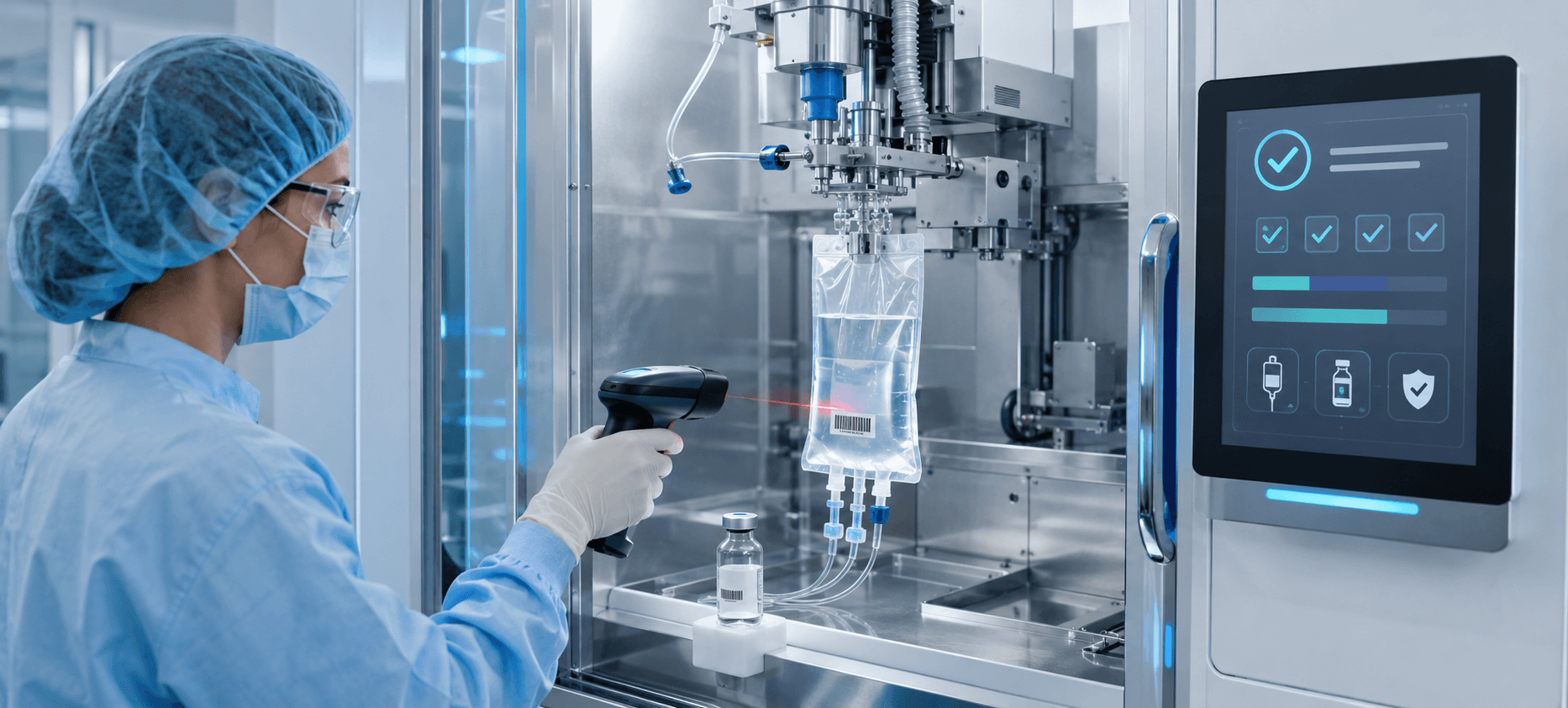
The Importance of Error Risk in Sterile Drug Compounding
Sterile drug compounding is among the practices that require the highest level of attention in TPN and Chemotherapy Units. Even the smallest error made while preparing intravenous (IV) drugs, chemotherapy drugs, Total Parenteral Nutrition (TPN) solutions, and other sterile preparations can directly affect patient safety.
Therefore, modern healthcare institutions aim not only to prepare the correct medication, but also to ensure that the entire compounding process is standardized, traceable, and controlled.
With advances in technology, automation systems, digital verification solutions, and quality management practices play an important role in reducing the risk of human error.
What Are the Most Common Human Errors in Sterile Drug Compounding?
Errors encountered during sterile compounding processes may arise from various causes.
The most common types of errors include:
- Selecting the wrong medication
- Preparing the wrong dose
- Using the wrong diluent
- Incorrect volume measurement
- Labeling errors
- Prescription interpretation errors
- Lack of barcode verification
- Failure to follow aseptic technique
- Incomplete recordkeeping
- Changing the compounding sequence
A significant proportion of these errors can be reduced through appropriate process management and technological infrastructure.
Main Causes of Human Error
Heavy Workload
Especially in large hospitals, the high number of prescriptions compounded each day can affect staff concentration levels.
An increased workload may raise the likelihood of errors due to factors such as:
- time pressure,
- loss of concentration,
- repetitive tasks.
Together, these factors can increase the likelihood of errors.
Excessive Manual Procedures
Manual dose calculations, volume measurements, and recordkeeping can increase the risk of errors.
Manual processes must be managed with particular care when prescriptions involve look-alike medication packaging and numerous different components.
Lack of Standardized Workflows
When staff members use different methods, processes may become inconsistent.
Standard operating procedures (SOPs) help ensure that all compounding processes are carried out using the same methods.
Communication Problems
Incomplete or incorrect information transfer may result in:
- overlooked prescription changes,
- use of an incorrect label,
- incorrect patient matching.
Such communication failures can compromise process safety.
For this reason, digital information sharing is critically important.
How Can Human Errors Be Reduced?
1. Establishing Standardized Workflows
Sterile drug compounding processes should be performed in accordance with established procedures.
Standardized processes ensure that the following are applied consistently in every operation:
- compounding sequence,
- control points,
- verification steps,
- recordkeeping procedures.
These elements can be applied consistently in every operation.
2. Double-Check Procedures
Having compounded prescriptions checked by a second healthcare professional can prevent many errors.
Double verification is particularly valuable at critical stages involving:
- patient information,
- medication name,
- dose,
- diluent,
- volume.
Verifying these details makes an important contribution to process safety.
3. Barcode and Digital Verification Systems
Barcode technology can match the following elements:
- the correct medication,
- the correct patient,
- the correct prescription,
- the correct compounding process.
These elements can be matched with one another within the system.
These systems reduce the manual control burden while also improving process safety.
4. Using Automation Technologies
Automation systems used in TPN and Chemotherapy Units provide significant advantages.
Automated drug compounding systems help reduce human-related variability by supporting features such as:
- precise dosing,
- standardized workflows,
- digital records,
- process verification.
By supporting these features, automated systems help reduce human-related variability.
Automation can make an important contribution to quality and safety, particularly in the preparation of TPN solutions and chemotherapy drug mixtures.
5. Staff Training
Personnel involved in sterile compounding processes should receive regular training.
Training content should be kept up to date in areas such as:
- aseptic techniques,
- use of new equipment,
- quality standards,
- safety procedures,
- emergency practices.
Keeping these topics up to date is essential.
6. Effective Use of Quality Management Systems
Quality management is not limited to auditing.
It is also an important management approach that supports:
- continuous process improvement,
- error analysis,
- planning corrective actions.
Together, these practices form an important management approach.
Why Are Automation Systems Becoming More Important?
The main reasons for increased investment in automation in TPN and Chemotherapy Units in recent years include:
Dosing Accuracy
Automated systems support the preparation of volumes in accordance with prescriptions.
Process Standardization
Each compounding operation can be carried out according to the same procedures.
Digital Traceability
Every compounded prescription can be recorded within the system.
Operational Efficiency
These systems enable more structured operations under heavy workloads.
Quality Control
Compounding processes can be monitored and audited more easily.
The Importance of the Sterile Compounding Environment
Reducing human error depends not only on equipment but also on the compounding environment.
Sterile compounding areas should incorporate practices such as:
- cleanroom standards,
- laminar airflow,
- appropriate temperature and humidity control,
- particulate control,
- regular environmental monitoring.
These practices support process safety.
When evaluated together with automation systems, this infrastructure helps create a more reliable compounding environment.
Process Management Through Digital Traceability
Today, healthcare institutions not only compound medications but also record the entire process.
The following information can be managed securely through digital systems:
- Patient information
- Prescription history
- Compounding time
- Medications used
- Batch numbers
- Operator records
- Quality control results
This information provides significant advantages for quality management, audits, and retrospective reviews.
The Future of Sterile Drug Compounding
As healthcare technologies continue to advance, sterile drug compounding processes are increasingly supported by smarter systems.
Applications expected to become more widespread in the coming years include:
- AI-assisted prescription verification
- Robotic drug compounding systems
- Real-time quality monitoring
- Digital risk analysis
- Remote performance reporting
- Smart inventory management
- Fully integrated automation for TPN and Chemotherapy Units
These technologies improve process safety while also contributing to greater operational efficiency.
Safe and Standardized Drug Compounding Processes with Er-Med
Success in sterile drug compounding depends on the coordinated use of the right technology, standardized workflows, and robust software infrastructure.
Automation solutions developed by Er-Med address the needs of TPN and Chemotherapy Units in TPN preparation, chemotherapy drug compounding, and digital process management.
Through precise dosing, digital record management, process standardization, and user-friendly software infrastructure, Er-Med aims to contribute to safe drug mixture preparation in TPN and Chemotherapy Units.
Although human error cannot be eliminated entirely from sterile drug compounding processes, the risk can be significantly reduced through the right technology, standardized procedures, and regular training.
Automation systems, barcode verification, digital traceability, and quality management practices are among the key components of a safe drug compounding culture in modern TPN and Chemotherapy Units.
For healthcare institutions seeking to achieve patient safety, occupational health, and operational efficiency goals, these systems offer long-term and sustainable solutions.
Frequently Asked Questions
What are the most common errors in sterile drug compounding?
Preparing an incorrect dose, medication mix-ups, labeling errors, inaccurate volume measurements, and failure to follow aseptic technique are among the most common types of errors.
Does automation completely eliminate human error?
No. Automation systems help reduce the risk of errors; however, proper process management, user training, and quality controls remain critically important.
Why is barcode verification important?
Barcode systems help verify that the correct medication is prepared for the correct patient according to the correct prescription and can reduce manual checking errors.
What benefits does digital traceability provide to healthcare institutions?
It enables compounding processes to be recorded, supports quality management, and allows retrospective reviews when necessary.