

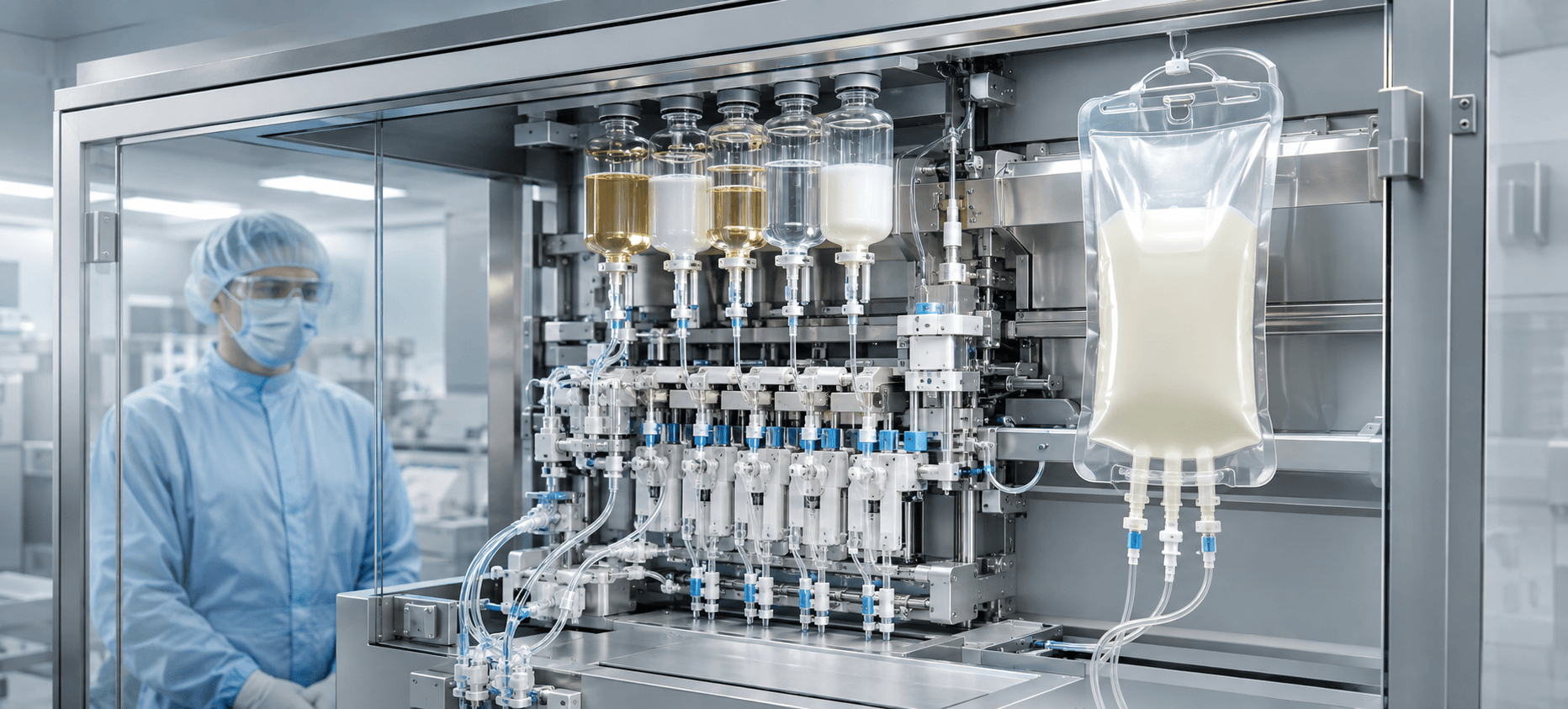
What Is a Fully Automated TPN Compounding System?
Total Parenteral Nutrition (TPN), used in the treatment of patients who require critical care, is among the procedures that demand a high level of accuracy and sterility. When oral or enteral nutrition is not possible, the protein, carbohydrates, fats, vitamins, minerals, and electrolytes required by the patient must be prepared in appropriate proportions and administered intravenously.
A Fully Automated TPN Compounding System is an advanced medical compounding system that automatically measures, mixes, and transfers different nutritional components into a TPN bag in the quantities specified in the prescription.
Compared with manual compounding methods, these systems provide much greater dosing accuracy, reduce the risk of human error, and standardize compounding processes. Fully Automated TPN Compounding Systems are now widely preferred, particularly in intensive care units, neonatal units, pediatric clinics, and oncology centers.
What Is Total Parenteral Nutrition (TPN)?
TPN is an intravenous nutrition method used for patients whose digestive systems are not functioning or who cannot receive adequate nutrition through other means.
In this treatment, all nutrients required by the patient are administered intravenously in a controlled manner.
TPN solutions generally consist of the following components:
- Amino acids
- Dextrose
- Lipid emulsions
- Electrolytes
- Vitamins
- Trace elements
- Sterile water
Because every patient has different metabolic requirements, each formulation is compounded individually. Even the smallest dosing error during the compounding process can therefore directly affect treatment.
How Does a Fully Automated TPN Compounding System Work?
Fully Automated TPN Compounding Systems use the physician-prescribed formulation as a reference and automatically transfer each component into the TPN bag at the specified volume.
The general workflow consists of the following steps:
Transferring the prescription to the system
The TPN prescription to be compounded is entered into the system or imported from the hospital information system.
Dose calculation
The system automatically calculates the required quantity of each component.
Automated dosing
Each liquid is transferred into the bag with high precision through independent channels.
Continuous monitoring
Throughout the compounding process, the system monitors flow rates and volumes.
Reporting
The compounded prescription is recorded, enabling retrospective traceability when required.
Differences Between Manual Compounding and a Fully Automated TPN Compounding System
| Manual Compounding | Fully Automated TPN Compounding System |
|---|---|
| Prone to human error | Performs automated dosing |
| Longer compounding time | Provides a shorter compounding time |
| Low repeatability | Provides standardized compounding |
| Records are created manually | Creates digital records |
| Higher risk of contamination | Suitable for a controlled compounding environment |
Automated systems provide significant operational efficiency benefits, particularly in healthcare facilities with high-volume compounding needs.
Why Is It Preferred in TPN and Chemotherapy Units?
Dosing Accuracy
The amount of nutrition required differs for every patient.
Fully Automated TPN Compounding Systems deliver prescription-compliant preparations through milliliter-level dosing accuracy.
Reduction of Human Error
Manual calculation and measurement errors may occur under intensive working conditions.
Automation can significantly reduce:
- the use of incorrect volumes
- missing components
- sequencing errors
in the compounding process.
Support for the Sterile Compounding Process
TPN solutions must be compounded under sterile conditions.
Automated systems:
- support closed-transfer processes,
- reduce contact with the external environment,
- help lower the risk of contamination.
Time Savings
TPN Units may compound numerous TPN bags during the day according to different patient prescriptions.
A Fully Automated TPN Compounding System:
- shortens compounding time,
- reduces staff workload,
- improves operational efficiency.
Traceability
In modern healthcare systems, it is essential to maintain records of every medication compounded.
Fully Automated TPN Compounding Systems can enable the recording of data such as:
- prescription information,
- components used,
- compounding time,
- operator information.
These records support effective monitoring and retrospective review.
For Which Patients Is It Used?
TPN therapy may be used for different patient groups.
Examples include:
- Premature infants
- Patients in neonatal intensive care
- Intensive care patients
- Cancer patients
- Patients with gastrointestinal disorders
- Patients who have undergone major surgery
- Individuals with malabsorption disorders
Because each patient requires an individual prescription, automated dosing is critically important.
Benefits of Fully Automated TPN Compounding Systems for Healthcare Facilities
Operational Efficiency
By reducing compounding times, more prescriptions can be completed in less time.
Standardized Processes
Every prescription can be compounded according to the same quality standards.
Resource Management
Staff resources can be used more efficiently.
Quality Management
Compounding processes can be integrated more easily into quality management systems.
Patient Safety
Compounding the correct prescription at the correct doses supports treatment safety.
The Importance of Domestically Manufactured Fully Automated TPN Compounding Systems
Domestically manufactured medical systems can provide healthcare facilities with significant advantages not only in equipment supply, but also in technical service, spare parts, and training.
The main benefits of working with a domestic manufacturer include:
- Faster technical support
- Easier access to spare parts
- Faster scheduling of user training
- Effective management of maintenance processes
- Long-term service continuity
Solutions developed in line with local requirements can also offer features that better address the operational needs of healthcare facilities.
The Future of TPN Compounding Systems
As healthcare technologies advance, TPN compounding systems are becoming smarter and more integrated.
Key developments expected to become more prominent in the coming years include:
- Full integration with hospital information management systems
- Barcode- and RFID-based verification
- Advanced user authorization
- Remote monitoring and reporting
- AI-assisted prescription verification mechanisms
- Advanced data analysis and traceability
These developments aim to support patient safety while improving the operational efficiency of TPN and Chemotherapy Units.
Fully Automated TPN Compounding Systems are among the key technologies that contribute to the safe, accurate, and standardized preparation of total parenteral nutrition solutions in TPN Units.
With benefits such as dosing accuracy, faster compounding, fewer human errors, and digital process traceability, these systems have become an important part of modern healthcare infrastructure.
Particularly in healthcare facilities with high patient volumes, automated TPN compounding systems offer solutions that support both operational efficiency and patient safety.
Frequently Asked Questions
What does a Fully Automated TPN Compounding System do?
A Fully Automated TPN Compounding System is a medical system that automatically compounds total parenteral nutrition solutions in the proportions specified in the prescription.
Where is a Fully Automated TPN Compounding System used?
It is used primarily in TPN and Chemotherapy Units, as well as in compounding processes that support intensive care, neonatal care, and oncology services.
What are its advantages over manual compounding?
It offers benefits such as greater dosing accuracy, a lower risk of error, faster compounding, and digital traceability.
How does a Fully Automated TPN Compounding System contribute to patient safety?
It helps ensure prescription-compliant dosing, standardizes the compounding process, and supports the reduction of human error.